

One of the most intimidating parts of being a business coach is setting your rates. Many coaches, especially new ones, have yet to reach a level of confidence where they know their worth and are comfortable charging that price.
If your rates are too high, you risk booking fewer clients, but if your rates are too low, you’ll scare off high-value clientele. So, where’s the sweet spot — one that is right for clients and also meets your revenue goals? In this article, you’ll get details on how to set rates that reflect your skill and value.
How Much Do Business Coaches Charge?
When it comes to the coaching industry, the landscape of rates is as varied as the coaches. What you charge will depend on a few factors — your niche, your experience, and even your primary location. Most coaching niches start around $50-$100 an hour for their services, but business coaching differs.
your price becomes a reflection of the results that you create for somebody.
Howard Mann, on the Coach Factory podcast
Businesses have budgets, and they’re usually willing to allocate a good chunk of it to bring in someone who can transform their operations, team dynamics, or bottom line. For this reason, business coaching rates usually soar to upwards of $500 an hour, sometimes more for highly specialized or high-demand coaches. And, if you package your services well, you could be looking at long-term gigs that keep your pockets and your schedule full.
Four Factors That Affect Business Coaching Rates
Because business coaching rates are not a one-size-fits-all situation. there are a few things to consider before setting your price. Let’s dive into four factors that shape business coaching rates.
1. Experience and Credentials
Your experience and coaching credentials are the most important aspect of your coaching business. You can have all the charm and charisma in the world, but clients only want to know, “What have you done, and who have you done it for?”
If you’re light on experience or qualifications, it will be more challenging to translate a nice personality into dollars. On the flip side, if you’ve got years in the game and perhaps a few certifications or degrees to your name, you get to set higher fees. Businesses are looking for coaches who bring proven expertise and a track record of success to the table.
2. Target Market
Understanding your target market is essential to setting your rates. You have to know who you’re talking to, what they need, and what they’re willing to pay for it. This isn’t about price gouging; instead, it’s about delivering value that’s proportional to your clients’ needs and expectations.
Small businesses are the backbone of our economy, but they usually operate on a leaner budget. They might need help with specific, tactical issues like boosting sales or improving customer service. These clients are often looking for quick wins to propel their business forward, and they may need more cash flow for long-term commitments. So, if you’re serving this market, your pricing should reflect their reality.
On the flip side, your pricing strategy will differ if you’re targeting corporate clients. They may require extra work — comprehensive training programs, ongoing strategy sessions, and team-building initiatives. These companies often have specialized needs and budgets to match. They’re not just looking for a coach; they’re looking for a business partner to invest in their growth and help them navigate complex challenges.
3. Geographical Location
Are your clients coming from booming metropolises or quaint small towns? Location impacts your bottom line in a big way. It influences not just what you charge but also what your potential clients are willing to pay.
But what if you’re coaching online? Does location still matter? Yes, clients from different regions have different perceptions about what coaching should cost. A New York-based CEO might raise an eyebrow at rates that seem too low, thinking you’re not up to par. They’re used to a specific price point, and they expect to pay for top-tier service. But a small business owner from a smaller town might cringe at what they see as exorbitant fees, not understanding the higher cost of doing business in big cities.
When it comes to international clients, currency conversion rates can either work in your favor or against you, depending on your client’s primary location.
4. Specialization
Are you a jack-of-all-trades or a master of one? Specialization can be the key to unlocking higher rates. Whether it’s strategy, operations, leadership development, or another sub-niche, your specialized skills can demand a premium price. When a business has a specific pain point, they’re willing to pay top dollar for an expert who can solve it.
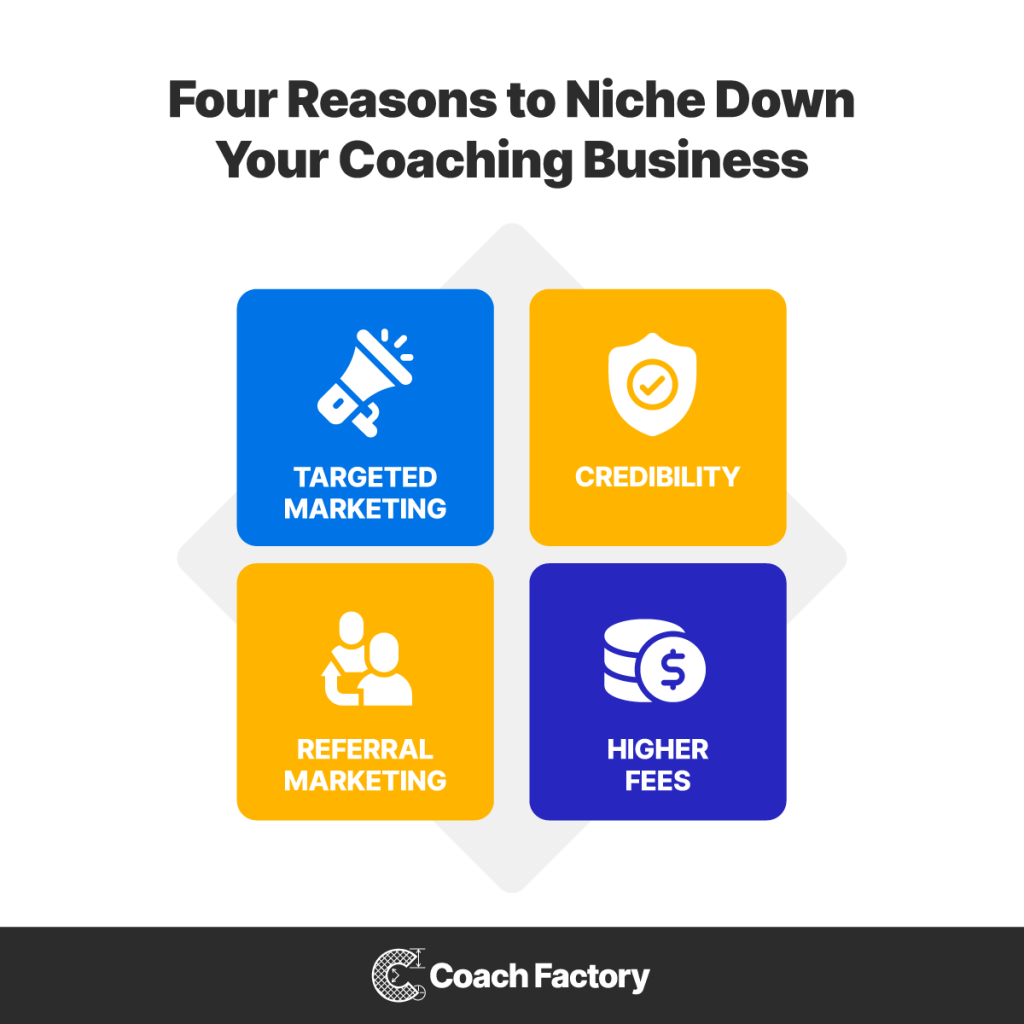
Don’t underestimate the power of specialization. When you’re known for one thing, word gets around. Clients start seeking you out because they’ve heard you’re the best at what you do. So, not only do specialized coaches attract more clients willing to pay higher rates, but they often spend less time and money on marketing.
If you’re looking to up your earning potential, specialization is key. Pick your lane, become the best in it, and watch how quickly businesses are willing to invest in your top-tier expertise. Your specialized skill set is your golden ticket to higher fees and a more focused, effective coaching practice.
Pricing Strategies for Business Coaches
Your coaching business can leverage one, two, or all three of these pricing strategies.
1. Hourly Rate
The hourly rate model is the most straightforward pricing strategy. This is where clients pay you based on the time you spend coaching them. You set a fixed rate per hour and bill clients either post-session or after an agreed-upon number of hours.
Hourly rates are often favored by new coaches who are still establishing their market presence. This model provides flexibility and is easier to explain to prospective clients. It’s also ideal for coaches who deal with straightforward, tactical issues that may not require a long-term engagement.
2. Tiered Packages
In a tiered package model, you offer multiple packages — usually categorized as some variation of basic, intermediate, and premium. Each package offers an increasing level of service and attention, and naturally, the prices increase accordingly. This allows clients to select the package that best suits their needs and budget.
While tiered packages offer the benefit of catering to a broader range of clients, they require careful planning to ensure each package is both profitable for you and valuable to the client. Track the time and resources each tier demands to ensure you’re not overextending yourself or undervaluing your expertise.
3. Retainer Model
In a retainer model, clients pay a monthly fee for ongoing access to your coaching services. The scope of work is typically outlined in advance and may include services like regular check-ins, strategy sessions, and unlimited email support. This model is for sustained, long-term engagements.
Retainers are ideal for coaches specializing in long-term business growth, change management, or leadership development. It’s best suited for those who prefer deeper, ongoing relationships with clients and offer services requiring regular check-ins or consistent follow-up.
While the retainer model offers financial stability and the chance for impactful coaching, it’s crucial to be mindful of your commitments. Ensure that the scope of services provided aligns well with the retainer fee and that you can fulfill them without compromising the quality of service for any client.

How To Set Your Business Coaching Rates
Still struggling to figure out how much to charge for your business coaching services? Setting your rates can be a daunting task, but it’s crucial to ensure that you’re not selling yourself short or pricing yourself out of the market. Below is a starting point in helping you determine how to properly charge your worth.
This conversation around rates is about income.
Howard Mann, on the Coach FActory podcast
Step 1: Calculate Your Base Rate
First, you have to determine your worth as well as your costs. Add up all your monthly expenses — everything from your personal living expenses to business costs like your home office and software subscriptions, etc. Be sure to factor in 25-33% for federal taxes and any applicable state taxes. Once you have that number, divide it by the number of hours you plan to work each month. This gives you a base rate, the bare minimum you need to earn to keep your practice running.
Example
If your monthly expenses total $2,450, and you want to work 20 hours per week, your base rate will be $30.63 per hour.
$2,450/(20 hours per week x 4 weeks)=$30.63 per hour
Step 2: Factor in Your Experience
If you have credentials or years of expertise, that needs to be reflected in your price. A common approach is to add a percentage to your base rate for every year of experience or for each significant credential you hold.
Example
For instance, if you have 10 years of experience, consider adding 20 percent on top of your base rate.
$30.63 x .20= $6.13
New rate: $36.75
Step 3: Consider Your Target Market
Your target market plays a huge role in how you price your services. Coaching a small business owner or a solopreneur is a different beast compared to coaching a team at a Fortune 500 company. If you’re aiming for high-budget clients, your rates should match the premium services they expect.
Step 4: Price Your Packages
To figure out pricing for packages, take your expenses (your necessary income figured above) and divide by the maximum number of clients you can take each month. If you plan to work 80 hours per month, 3-4 clients is feasible.
Example
If you have three clients per month, your base package price would be $816.67.
Expenses: $2,450/3 clients per month= $816.67
From here, you can scale up a few hundred dollars per package tier, for example:
- Basic Package: $816.67
- Value Package: $1,116.67
- Premium Package: $1,416.67
Step 4: Account for Geographical Location
Remember that where you or your client’s location can affect how much you can realistically charge. If you’re operating out of a high-cost area, you’ll need to set your rates accordingly. Even if your coaching is online, businesses in high-cost areas may be willing to pay a premium.
Use a cost of living calculator, to determine how much to appropriately increase your rates. If you’re servicing a larger city, like New York City or Los Angeles, look to add a 35-45 percent cost-of-living increase.
Step 5: Add a Specialization Surcharge
If you have a specialization in a specific area, like strategy or leadership, that’s another layer to add to your pricing. Specialization allows you to charge a niche premium. So, don’t be shy; add 15-25 percent to your base rate if you offer specialized services.
Example
This is how your rate and packages could look with a specialization upcharge:
- Base Rate: $36.75 x $0.20=$44.10/hour
- Basic Package: $816.67 x $0.20=$980.00/per month
- Value Package: $1,116.67x $0.20=$1,340.00/per month
- Premium Package: $1,416.67 x $0.20=$1,700.00/per month
Step 6: Review and Adjust
Pricing strategy isn’t a set-it-and-forget-it situation. Periodically review your rates to make sure they align with your growing expertise and the market’s demands. If you’ve just completed a high-profile project or gained a new certification, it might be time for an increase.
