When you’re a business coach, your game is all about turning ambition into action, transforming dreams into deeds. But the question is, how do you help clients navigate the maze of corporate life?
Goal setting is a crucial part of this process, as it allows your clients to transform their dreams and KPIs into concrete achievements. Instead of taking giant uncalculated leaps, a business coach guides business professionals in taking strategic steps to accomplishing their objectives.
This article is your definitive guide to helping your clients set and achieve impactful business goals that create thriving businesses.
The Role of Business Coaches
As a business coach, your role is far more than just being a cheerleader or a sounding board. You serve as a strategic partner and an accountability anchor.
First, you help your clients identify and articulate what they really want to achieve — often, this happens through a process of discovery where you guide them to dig deep and lay bare their core objectives. Then you work with them to break these big ambitions down into actionable, measurable goals.
You also bring an external perspective that sees through the internal biases and blind spots a client may have. Throughout the journey toward achieving these goals, you provide feedback, monitor progress, and adjust strategies. Lastly, you deploy the use of your tools and resources to help make the journey easier for your clients.
Five Simple Steps for Setting Goals with Business Coaching Clients
There are a ton of frameworks out there that help clients set goals and we will cover a few of them later in the article. Sometimes it helps to explore the basic framework first, and build upon it. This is how coaches develop their own unique coaching methodologies. Here are the five most important steps for helping your business coaching clients set goals.
1. Conduct an initial assessment
The initial assessment gauges where your clients currently stand in their business. It gives a clear picture of metrics, financial health, team dynamics, market position, and other professional challenges they’re facing.
It provides an accurate starting point for setting realistic goals and focused strategies.
2. Identify and breakdown objectives
Work with your clients to map out their primary goals, whether that’s revenue growth, team collaboration, or product diversification. This focused approach keeps clients from scattering their energy on too many fronts.
Once the core objectives are clear, break them into smaller, actionable subgoals. Breaking down the main objectives makes the journey much more achievable and less intimidating.
3. Prioritize tasks
Not all tasks have equal weight in achieving the end goal. By prioritizing these tasks based on urgency and potential impact, you help clients focus their energy and resources where they matter most. This strategic approach eliminates guesswork and ensures that the goal strategy doesn’t neglect pivotal tasks.
4. Allocate the required resources
Define all available resources — be it time, money, or human resources — and assign them to each step. For example, if an objective is to increase team collaboration, a resource may include implementing a project management tool to help.
Adequate resourcing avoids burnout and overextension, increasing the likelihood of success.
5. Develop an action plan
Developing an actionable coaching plan is a crucial final step in goal-setting with your business coaching clients. It involves creating a comprehensive timeline or roadmap that outlines tasks, assigns responsibilities, and sets deadlines. Every task that has been prioritized and resourced now needs a who, what, and when — essentially giving a person, defining the task, and setting a due date for it.
With a detailed action plan, it becomes easier to track performance, make necessary adjustments, and hold clients accountable for their responsibilities.

Top Four Goal Setting Frameworks for Business Coaches
Coaches have a dual role that extends beyond simply defining targets. They must not only help their clients articulate precise, measurable goals, but also equip them with the skills and mindset needed to turn these goals into tangible outcomes. To navigate this, there are a few goal setting frameworks that will help you guide your clients.
1. CLEAR
The CLEAR framework offers a more fluid, adaptable approach to goal-setting than traditional models like SMART (described below). In the CLEAR framework, goals should be
- Collaborative by encouraging teamwork and involving relevant stakeholders.
- Limited to an achievable scope.
- Emotional to prompt action.
- Appreciable enough to be broken down into smaller tasks.
- Refinable to increase flexibility and adaptability in rapidly changing conditions.

CLEAR goals are particularly effective for businesses operating in volatile environments or for long-term projects that require constant re-evaluation and adaptation. They account for the emotional and human aspects often overlooked in business settings.
On the downside, the flexible nature may lead to delays because of the constant refinement of goals. Furthermore, the emotional aspect might only suit some organizational culture or objectives.
2. GROW
The GROW framework is a coaching model that stands for Goal, Reality, Options, and Will. This model provides a structured approach to problem-solving and goal-setting, helping clients move from their current situation (Reality) to where they want to be (Goal) by exploring various paths (Options) and committing to action (Will).

This model is popular for its simplicity and effectiveness. It encourages a conversation that facilitates clarity while sparking insights. Its structured approach makes it easy for coaches to guide their clients through a thought process that promotes self-discovery and actionable steps.
Even though the GROW model is versatile, it may not be ideal for complex issues that require deeper analysis or long-term strategizing.
3. Golden Circle
The golden circle framework focuses on three concentric circles that represent the why, how, and what of goals. The central circle represents the belief or purpose driving the goal. The middle circle signifies the methods or processes used to achieve the why. The outer circle indicates the available resources.
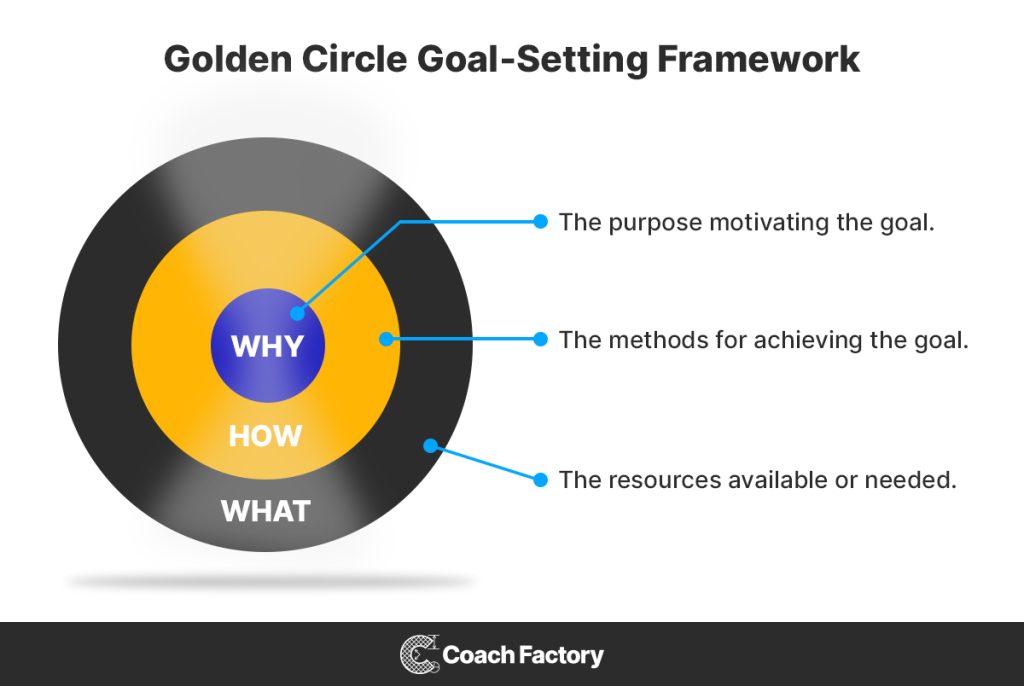
The golden circle framework encourages deep introspection by helping clients understand not just what their goal is but why they want to achieve it. By starting with the why, the framework helps instill a sense of purpose and mission that is incredibly motivating. For business coaching, this tool offers a powerful means to align team members and guide organizational decisions based on a central, inspiring objective.
The primary limitation of the golden circle is that it’s conceptually abstract. It can be challenging to quantify the why, making it difficult to measure and analyze practically. Additionally, the model might oversimplify complex business issues by attempting to reduce them to three core elements.
4. SMART
The SMART framework is one of the most commonly used goal-setting tools in business coaching, and for good reason. The acronym stands for Specific, Measurable, Achievable, Relevant, and Time-bound, each serving as a standard to guide the creation of objectives.
The SMART framework’s structured approach forces the coach and client to think critically about the goals they’re setting. It eliminates vagueness, compelling clients to specify exactly what they want to achieve. The measurable and time-bound criteria ensure that progress can be tracked over a set period, while achievable and relevant assure feasibility and alignment with broader business strategies.

SMART goals are excellent for short-term objectives and projects that require tactical planning. They offer clarity and are easy to communicate to teams. Where SMART may fall short is in long-term, more visionary planning. The rigid structure may inhibit the flexibility and adaptability required in business settings.
This framework benefits startup entrepreneurs, managers in transition, or anyone looking to make swift, noticeable changes in their business operations.
Goal Setting for Business Coaching Clients
In the high-stakes business arena, setting the right goals isn’t just beneficial; it’s essential for survival and growth. The more adept you become at strategic goal setting, the more indispensable you will be to your clients.
Want to help your clients set and achieve more ambitious business goals? Download the Coach Factory Goal Setting for Business Coaching Worksheet to help your business coaching clients thrive.
Business Coaching Goal Setting Worksheet
Turn business aspirations into realities! Give this worksheet to your client as an initial step in the goal-setting process. Your client's answers will help the two of you to cooperatively identify and refine goals for the business coaching process.